
Cylinder head gasket, Head surface thickness and Compression ratios.
QUESTION
Subject: Little Gem
Hi Neil, Got the head off today . Discovered two head gaskets fitted? Also holes in Nos 1& 2 pistons. Unfortunately no piston sizes stamped on top of pistons, so need to measure when removed Thought you would be interested.
ANSWER
Sounds like the compression ratio was too high, the head might be a bit ‘thin’ if too much metal has been removed. If the head is 74.37mm its been machined to an 8.6:1 compression ratio; if machined to 73.575mm its a 9.3:1 ratio, But this all makes the head face metal thinner and can cause head gasket problems. The ‘standard’ thickness from the factory is 76.75mm.
Low Oil Pressure
QUESTION;-
I’ve a friend who has bought a TD, it has low oil pressure and I noted the oil gauge pipe is connected to the top of the narrow rocker feed pipe to the cylinder head. Is this correct?
ANSWER;-
The rockers get an oil feed of about 10-20psi to stop flooding the head (and causing high oil consumption). The narrow pipe from the oil gallery to the head is the ‘restriction’ in the system, it limits the pressure. The oil gauge pipe must be connected to the main oil gallery at the base of this pipe to read the engine’s oil pressure. Your friend’s is reading the controlled pressure to the rockers; its fitted the wrong end of the pipe (not uncommon). The photo shows the top banjo connection to the head far right, gauge pipe connect the lower end.
Cylinder head gasket round hole/oval hole. Rocker shaft. Cam followers. Tappet noise
QUESTION :-
I am writing to you as an acknowledged authority on XPAG engines, although it involves a TD, Wolseley 4/44 as well as my YB.
The 1952 TD is a US import and has an early TF block with round coolant holes but what I believe to be theoriginal oval waterway head. The oval waterway gasket has failed as I believe it should have been fitted with the round hole type.
1.I wish to fit a round hole Wolseley 4/44 unleaded head is this possible?
2. Do you recommend coating the new head gasket with, grease, Hylomar or fittig it dry?
3. The Y-Type engine is running well. It has a replacement rocker shaft and bushes but has annoying tap with the correct valve clearances. Cam follower faces seem ok. Any ideas?
Hope you are able to help and that you continue to enjoy using your YB.
ANSWER:-
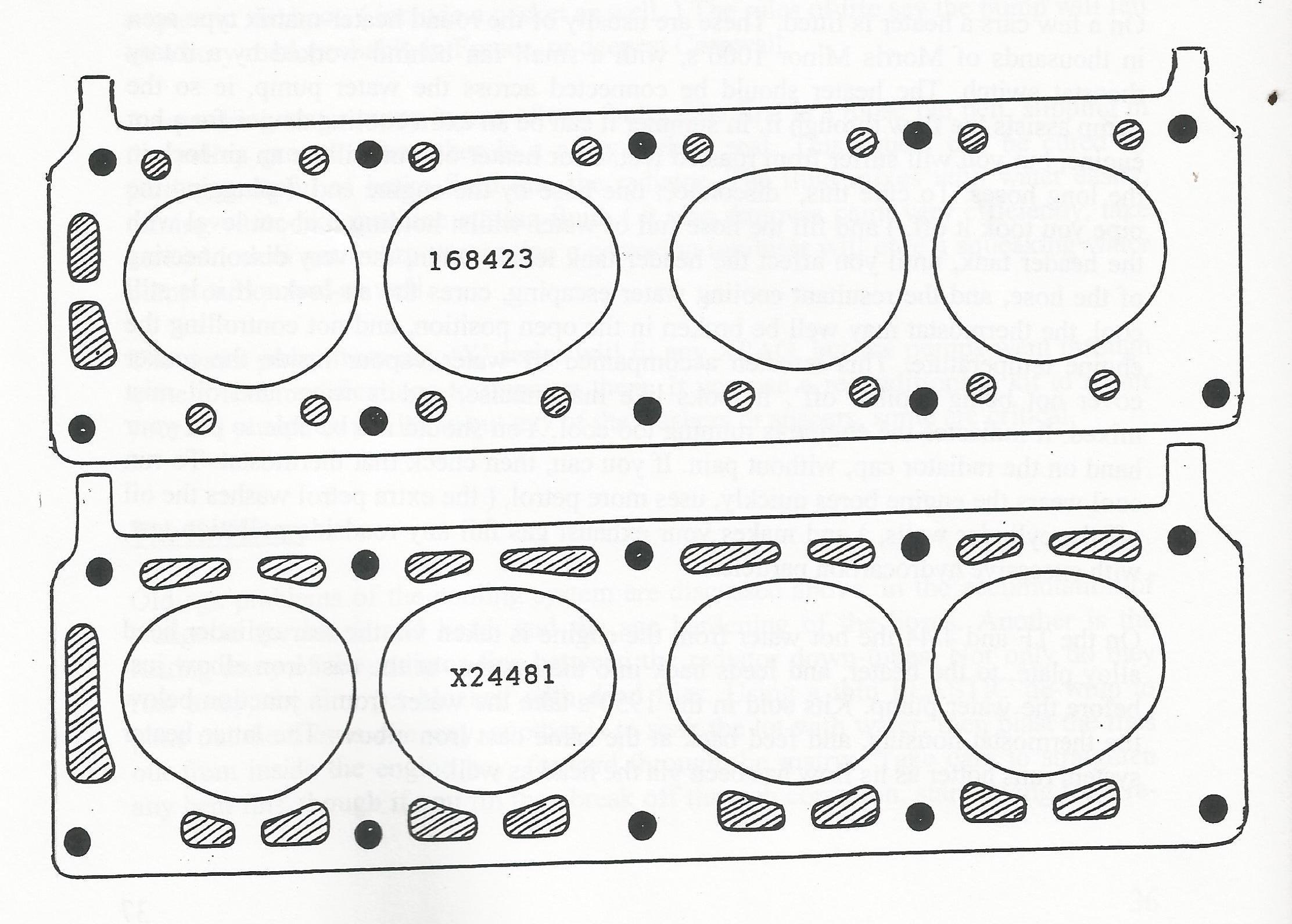
If you mix a round hole with an oval hole head/block, you must use an oval hole gasket. The reason is that a round hole gasket’s edges will not be crushed between the two items. If you see the modification list in the book, MG mixed them for ages as they used up old stock
4/44 head is identical but you cannot use the rear heater feed on a Y Type, not enough room between the rear of the head and battery box. It should be OK on the TD as there is more room there.
A thin smear of grease on the head with the burrs removed around the studs (you’ll need to remove them to file the burrs!!!)
AHA! Mine does this as well. Like you I fitted a new rocker shaft and new bushes but I simply could not get rid of No2 tapping away. I eventually found it was the cam follower. There is wear sideways in the follower’s hole and it rocks back and forth only about 2-3 thou but ticks away monotonously. On Gold Seal recon-engines they fit 0.010″ over-size followers, my engine already has them. Its been ticking away now since 2011 and seems happy. There is a method of checking for a 0.012″ tappet gap camshaft or a 0.019″ tappet gap camshaft in the book (attached).
Starter Motor Bendix Compatibility with the Fly Wheel.
Question:-
I hope you don’t mind me contacting you regarding an ongoing problem I am having with the starter on my TD.
It’s a long story, and is as follows, the original Xpag engine had to be replaced and thus was done using an XPaw engine I purchased from Royston, and was fitted by Kieran. The starter was occasionally jamming and after checking this I have discovered that it is only engaging the ring gear by about 8mm, I have tried fitting a 10mm space4 and this results in it jamming completely. I spoke to Kieran and he has assured me he did a starter ring gear match when he rebuilt the engine, as the flywheel was off my original Xpag engine, I should mention that the starter had a nine tooth bendix fitted, I have also changed thus to a ten tooth bendix to no avail. I discussed all this with Graham who was at a loss and suggested I contact yourself. Whilst the set up is starting the car okay, my concern is that long term it will take the edge of the ring gear teeth.
Answer:-
You’ve hit a problem here because there was a change of flywheel teeth number and a starter change, quote from the modification list, ”
5) In 1949 the TC was replaced by the TD, based on the excellent but modified YA chassis and running gear. The first TD engine was XPAG/TD/501. With the new model a new C45Y dynamo, M418G starter and flywheel starter gear ring were fitted, at TD/501 and SC/14023. The new starter only has two bolts, not three. TD engine numbers very quickly catch up the YA, then overtake it. TD used the Y sump.”
There is no way of knowing that, in the past, an earlier flywheel has been fitted or not. The starter type for the earlier version is a Lucas M.418G, Type L/G, part number 255378 (this will be stamped on the body somewhere). The later one is a Lucas M.35.G1 part number 25022D. The later starter is smaller and (I quote the manual here) “….must only be used in conjunction with flywheel stater ring part number X.244418 (stamped on the side of the ring).
So if you have a later M.35.G1 with a two bolt fixing, the starter ring must be a X.24418, or it will jam! As I’ve mentioned, because of the ease of swapping bits around, you may well have odd parts. Normally the TD and YB use the NINE-tooth, the technical article on the MG Y Type Register website is, < https://www.mgccyregister.co.uk/y-type-starter-motors/ > which shows the swapping of that gear.
I can only guess you might have the wrong starter motor? The three-bolt one will fit the later two bolt fixing (my YB had one when I first bought it in 1995, but it has an early Gold Seal replacement engine from a YA). Using a TEN tooth wheel will wear away the ring teeth very quickly ( or jam up) as the tooth engagement will be wrong. Many exchange starters these days have nine tooth gears fitted (most BMC cars used a similar one on the Morris Minor, etc).
Starter Motor Removal
Question:-
I have a faulty starter motor on my YT so I have removed the bulkhead and rad stays and have managed to get the starter out of the bell housing but there it is stuck, cannot remove it from the car. I have not dropped the exhaust (at 75 crawling underneath is something I would like to rather not do!!) Can you tell me if it is possible to get the starter motor out without dropping the exhaust?? As a last resort I will have to crawl underneath but I would value your advice.
Answer:-
I removed the inlet/exhaust manifold to get mine off, the exhaust pipe stays where it is. I’m also 75!!!!
Crankshaft Pulley
Question:-
The bottom pulley on the crankshaft has about 5mm side to side movement (slack) – how big an issue is this.
Answer:-
Do you mean ‘radially’ or ‘back and forth’? If its back and forth the big nut requires tightening. If its ‘radially’ the keyway may be worn. As the pulley only drives the pump and dynamo, you might be able to tighten up the big nut (you’ll require a box-spanner as a socket will not get over the starter dog ***OR*** use the starting handle). It ‘SHOULD’ be locked with a locking washer that has a tag into the keyway and and edge folds over the nut flat. If that washer is missing, fit one (from MGOctCC), without it the nut will only loosen again with vibration. If the slack is radial, and too much, you need either/or both, a new key and/or a new pulley.
WARNING….the seal on the timing chain cover/sump is asbestos string, it is infamous for only sealing for a few miles then weeping. You may need to loosen off the sump a bit to get a ‘new’ pully to fit. Many amateurs fit the sump and timing chain cover then try to fit the pulley….the pulley goes on temporarily before these two items are fitted so the ‘seal’ is crushed to the correct dimensions. It needs removing again to get to the bolts on the timing cover to tighten them. Nothing is straight-forward on an XPAG, or other engines of that era.
Head Gasket Leaking
Question:-
I have just filled my car up with water prior to engine test and water was leaking from cycl head in the 2 corners opposite side to the manifold. I was advised to have washers under the head nuts. Is this ok. I have the right gasket but ordered another. Any ideas advice before a second fit?
Answer:-
There should of course be no leaks! Is the head flat? Does it need a 0.005″ skim? Are you using the RIGHT gasket? If you’ve a round-hole and an oval hole mix you can ONLY use the oval-hole gasket. Using a round-hole gasket with any oval-hole part will mean the rolled edge of the copper will not be sealing the area. Are the nuts ‘binding’ on the stud threads ( are the threads too short in other words), if so using a thicker washer might help.
Piston and Bearing Sizes.
EXPAG identification No
QUESTION;-
I am looking at buying a YT from Australia. There is some discrepancy with the engine number. The number on the brass plate fixed to the crankcase is XPAG/SC/10506 but the number on the plate fixed to the body is XPAG/TR/10506. Do you consider this would be a problem when trying to register with DVLA & what is the difference between the TR & the SC?
ANSWER;-
According to LTBYs prefix SC and TR both apply to your car SC stands for Silencer Chamber which was a bit different for export models as they had the Oil bath type air cleaner. The TR stands for Tourer Right hand drive. TL would have been Left hand drive.
So I am pretty sure it would not be a problem for the DVLA
Bore Size
QUESTION;-
My question is, if you removed the cylinder head and found all four bores were heavily stamped +.0005 (See Attached  Images) what would you expect the bore size to actually be, the unit is a factory replacement in the early 1980s having a number I/D plate RS 18024 and another plate with BMC Replacement unit part number AEF4. and shortly after was laid up for 28 years until I acquired it.
ANSWER;-
Factory engines and Unipart reconditioned engines (Gold Seal Replacements) had their pistons ‘selectively’ fitted. Once re-bored the bore was measured and pistons fitted to suit ( back then tolerances were not as accurate as today). Your’s was obviously half-a-thou oversize and got pistons to suit, also half-a-thou oversize! The actual re-bore size will be stamped on the piston crown and on a brass plate on the crankcase side (normally, 020, 040 and now 060 (the 60 thou oversize is NOT an MG size, but one sometimes you can get away with).
Head machining
QUESTION;-
For a car with a .060 re-bore (about 7.5 to 1 compression as I understand) how much do I need to machine off the face of the head to give about 8.5 to 1?
ANSWER;-
According to the manual, removing 3/32″ raises it to 8.6:1, 1/8″ to 9.3:1.
(with a standard bore.)
Oil pressure
QUESTION:-
Starting my TC with TD engine my oil pressure gauge takes 5 seconds to reach 20 p.s.i. then takes a further 40 seconds to reach 42 p.s.i. with higher rev s and maintains this whilst driving.On turning the engine off the gauge drops to 20 p.s.i then stops for a few seconds before dropping to zero. I have had the gauge checked no problem .All the pipes have been cleaned out.Is there a reason, and can I cure it thanks Dave C
ANSWER:-
 Quite normal. The gauge itself reads what arrives in the tiny pipe and the ‘Bourdon Tube’ (the pressure tries to straighten it out, this movement works the needle) inside takes time to expand to then move the needle via a tiny rack-and-pinion. If its all cold it takes even longer. Whilst the pressure in the engine will be almost instant in the main oil gallery, it has to pass up a long, thin copper tube, thence through a rubber flexible tube, then into the gauge itself. The gauge is a cheap typical type of its age and is only an ‘INDICATION’. On stopping, you will get residual pressure still in the pipe as it releases itself back into the engine (Note there is no ‘FLOW’ only a pressure,). You are probably expecting too much from a simple, basically 1930s, mechanical system; a modern system from a digital pressure switch on the engine to an electrical gauge would read instantly. If you re-start from a warm engine it will probably read more quickly, its not the engine that is ‘SLOW’ but its indication system.
Casting numbers and tappet clearance
QUESTION;-
My main queries concern the block casting and the tappet clearance specified on the rocker cover.
The engine number is TD2 27504 made around April 53 and the chassis plate, the stamping on the raised portion of the block casting above the octagon brass plate and the number on the brass plate all agree with this number, so far so good. My query comes with the casting number on the block which should read 168421 round hole no octagon, as per your books articles etc. and publications such as Let There be Y’s but it actually reads 24240, it does not have an octagon, a number I can’t find any reference to anywhere.
My second query is related to the tappet clearance on the brass plate on the rocker cover it says 015″ not 012″ as I would expect or even 019″.
I the pile of documentation I got with the car there are notes concerning 2 engine re-builds one in 1987 and another in 2002 however they are not particularly helpful other that other than if the 87 one is to be believed somebody had messed with it pre 87 and assembled the con rods the wrong way round and fitted larger valve to the cylinder head which by the way has the correct casting number 168422.
ANSWER;-
Its stumped me as well!! Here are the casting numbers we know;-
Model/Item Casting Number .
Early Morris/Wolseley Ten 1140cc ‘X’ cylinder block, oval, 22500
Later post war 1140cc cylinder block, oval water holes, 24144
Early M.G. 1250cc ‘X’ block, octagon cast in, oval water holes, 24146
Later post war 1250cc M.G. block, octagon cast in, oval holes, 24445
4/44, later TD, & TF block, no octagon, round water holes, 168421
Early 1140cc cylinder-head, no centre oil drain, oval water holes, 22812
Early pre-war 1140cc head, with round holes. 22952
Later post war 1140cc head, same as early ‘T’ type, oval holes. 22952
Later TD, & Y oval hole cylinder head, short reach plug, 22952
4/44, TD & TF head, round water holes, long reach plugs, 168422
Late 4/44 head, round water holes, 168425
Note that the 22952 head’s use, MG one had bigger valves.
I can only suggest it may well be a cylinder block from one of the ‘industrial’ uses of the Morris engine. The block was also used as a generator engine in WW2 for the RAF at 1140cc (Morris Ten size), as well as a small Nuffield tractor engine and water pump unit for the fire services. It is ONLY a guess but you may well have one of these. It matters not as the blocks are nearly all identical, only the cylinder centres differ for 1140-1250-1466cc. A 1140 can be bored out to 1250, but it gets a bit thin on one side to the cooling spaces. The rocker cover is irrevelant, use the clearance for your type of camshaft (probably 0.012″). Rocker covers get swapped about a lot, and UNIPART Gold Seal exchange engines were given what ever was clean in the parts bin.
Neil.
FOLLOW UP:-
False alarm….Thank you very much for your advice and the book, I will study carefully, as I have a confession to make that is if I had read properly the description and photographs available I would not of made the foolish mistake of using some spurious number on the rear LHS of the block as the casting number which having looked in the correct place is as expected 168421 for the block and 168422 for the head!!!!
QUESTION
Engine Identification
l recently bought a copy of your book from the MGCC titled ” How to be an engine expert on MG’s ” to help me identify an engine l acquired about 35 yrs ago. Great book sir, but if possible l would appreciate your thoughts on what l have. The engine was bought from a scrap yard having been taken out of a car being dismantled on the understanding it was basically the same as the XPAG engine in the MG l was restoring and could well be useful for spares. (” they used to put this in the Wolseley 4/44 as well gov ! “)
The details are :-
The engine is gold.
On the head at the front is cast 22952 at the back is cast 4 6 5 ( or 4 G 5 )
Beneath the 22952 and on the block is an aluminium plate marked :-
BMC REPLACEMENT ENGINE
BORE SIZE +040″
CRANK SIZE R 2
PART No CA 908 R
On the other side of the block and at the front is cast MOWOG and the> number 22500 – at the back near the distributor is very crisply cast 26 MAY 39 T 5
Other part numbers are :-
Crank ESCM 19 22528
Cod rods 22809 -D3 – D7 – D13 – D12
Cam sprocket 22744C Q13
Carb manifold 22580 MC ( or MG ) ( Single carb )
The sump is smooth – the timing cover has the bulge and the air filter set up is all the same as the XPAG 1250 /SC in your illustration on page 26. l do have some photographs if you need them.
The questions l am now asking myself are which engine do l have and which parts if any are interchangeable with a 1946 and a 1952 XPAG 1250 engine.
l really would appreciate any help or advice you could give me on this and look forward to your reply.
ANSWER
You have an ‘SC2’ engine that was fitted to the Wolseley 4/44 and MG YB (the sump will decide which, the 4/44s has a big frontal extension, the YB has it to the rear.) The internals are identical to both 1949 and 1952 engines, its the sumps and flywheels that differ. A 1949 engine has a 7.25″ clutch, the 1952 engine has a 8″ clutch (you need to swap over the whole flywheels). It appears to be a ‘UNIPART’ Gold Seal exchange engine (UNIPART were BMC’s spares division) and they use their own part number system (not the same as Morris/Austin).’bore +040 means it is bored out to 40-thou (you can go out to +060” using pistons from the MG Octagon Car Club, but risk breaking into the water jacket). R2 is the crankshaft ground to its first regrind, (it will take another). A 1946 engine has the old type oil pump and the ’52 engine the oil pump with the oil filter as part of it, they can be swapped as complete units only. Otherwise all the internal bits are interchangeable. Photos would confirm my views. On the sports cars the engine had twin carburetors and on the TC a different camshaft, but the TD/TF shared the same cam as the YB/4/44.
QUESTION
Engine Identification
I hope you can help me, I am trying to identify a replacement engine that came with my 1939 MGTB. It appears to have been painted gold at one time, and I suspect it may be a Wolsey Gold Series Engine. There is no MG logo cast into the block. It does have a horizontal oil pump & filter and was running an 8″ clutch. It also
has a chain tensioner. The BMC replacement tag reads: B 8786 Part #168630 R AD. My British tax log book indicates that this engine was in it as of 1969 when the tax was paid. It was brought to the US in 1971 by a US naval officer that had been stationed in Edzell, Scotland. I am trying to determine the origin and the year of the engine in order to restore it. I thought it was a Wolsey 4/44 engine and should be equivalent to an MGTD Engine. I am missing some parts for it. I found a TD sump and the holes seem to line up, but when I received a TD cam cover over the internet, it did not match at all. I need to determine exactly what I have before proceeding any further. What is it and what type of parts do I order?
ANSWER
Sounds like a UNIPART Gold Seal exchange engine. They did not differentiate between TD, TF, YA,YB,YT or Wolseley 4/44, all were 1250cc. The 4/44 block has a dip-stick boss under the exhaust manifold. If this is undrilled, its a MG engine which will have its dip-stick by the distributor. A ‘cam cover’? Do you mean rocker cover? The steel pressing that sits on top of the engine? (The camshaft is inside the engine block.) I attach the book on MG Engines to help. The Wolseley 4/44 engine is identical to the YB and late TD (TD has twin carbs though), all have the oil filter horizontal from the oil pump casting.
FOLLOW UP
My dipstick is below the distributor, there is no hole or plug under the exhaust manifold. However, I thought all MG engines had the octagon logo cast into the block behind where the generator is mounted. Was this not true of the Unipart gold seal exchange engines? I meant the chain cover, not the cam cover and I have recently discovered that it does fit, provided the engine mounting plate is first in place. What do the numbers on the BMC Replacement tag tell you? I am wondering if I should be looking for early or late TD parts. It was still set up with 1 1/4 ” carbs with the TB, TC type air cleaner, not
the TD air cleaner.
I am very appreciative of all your help and knowledge.
ANSWER
Mike, I’ve found an old hard-copy of the book and scanned the sketches for you.

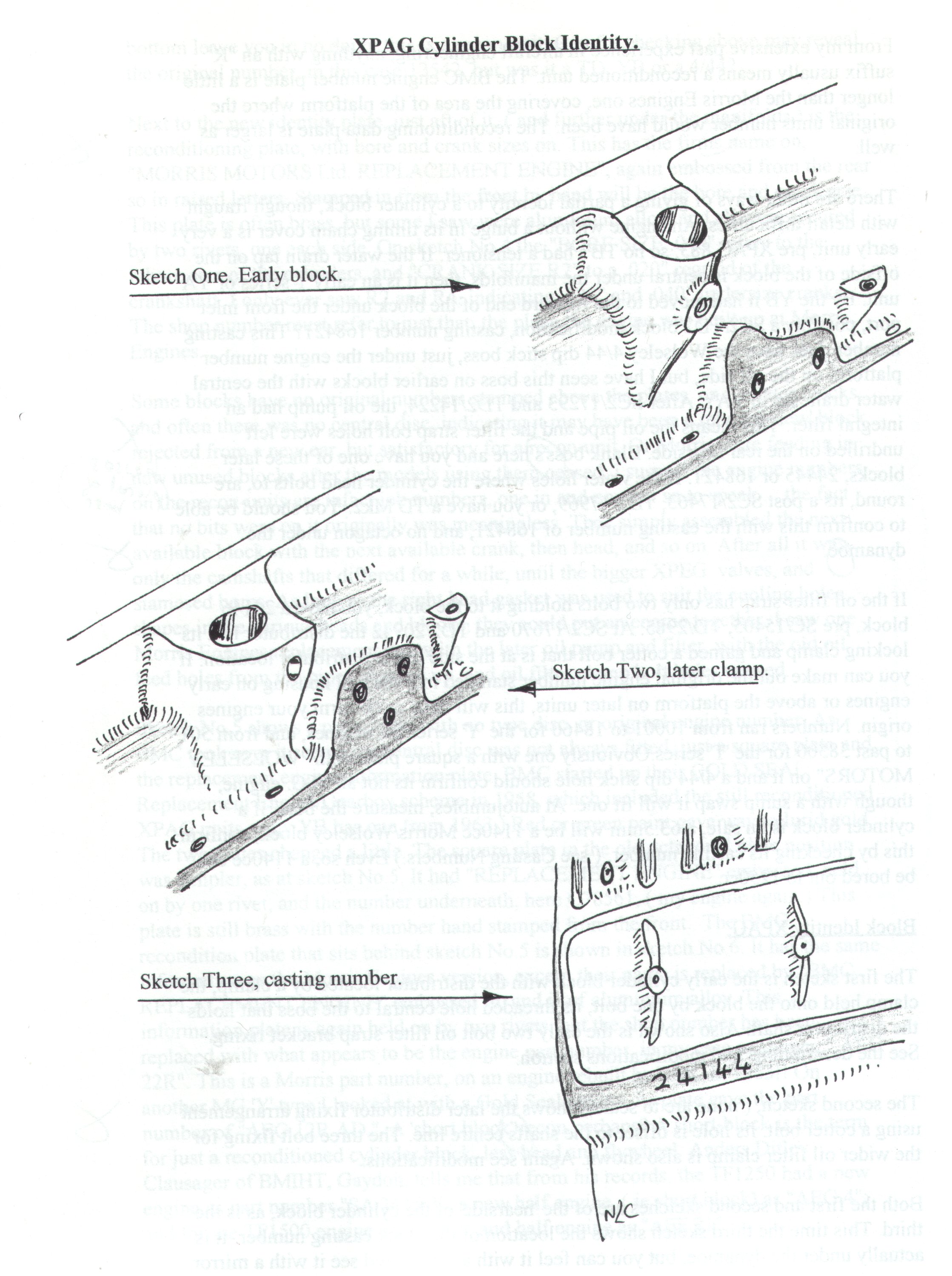
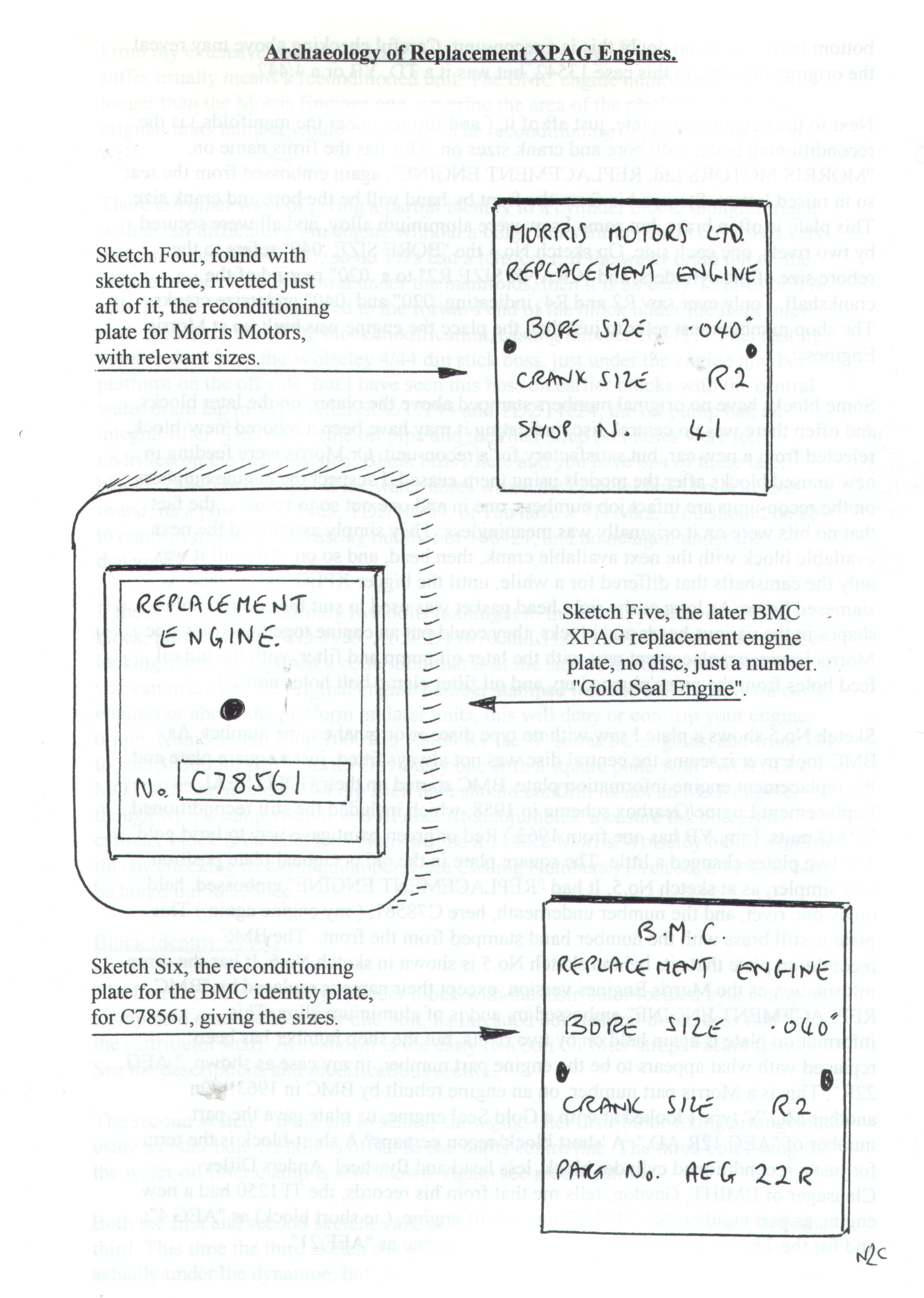

If you read the XPAG chapter, you’ll see that only the very early 1250cc XPAG engines had a ‘MG’ logo. Once the engine was used on other Nuffield products the motif was removed. If you have no dip-stick boss under the manifold, the engine is pre-Wolseley 4/44 (same block was used on all cars/tractors/boats). UNIPART Gold Seal engines used exchange engines, you bough their refurbished engine and gave them yours, for it to be refirbished and then swapped again; for instance my own 1952 YB had a Gold Seal unit fitted in 1966, but it is a YA unit with the old oil filter position. Back then people just wanted an engine, no one was fussy like they are today about ‘originality’. When your Gold Seal engine was fitted, it would have had all its ancillaries from the original engine fitted (you only got an engine, not manifolds, carbs, starter, distributor, etc.)The was a Silver Seal exchange engine that was ONLY the cylinder block, you re-used your own sump, head, flywheel, etc. There should be two little plates on the block under the carbs, one will be brass with the engine number/type/number on it. The other will be an aluminium plate with the rebore and crank under-size on it in a code (they are explained in the book I sent you). The ‘number’ given the engine by UNIPART, the BMC spares division, will NOT fit the original MG system, its their own number (but sometimes you can just see the block’s original number stamped above the brass plate…but not always. But then you will not know if it was originally from the Nuffield tractor, the Marine Navigator versions, a Wolseley 4/44, a TC, TD, TF, YA, YB, YT, the WW2 RAF generator, and so on and on. A smaller externally identical engine of 1140cc was fitted to the Wolseley 10/4 and the Morris Ten/4 and the Morris Ten van.
Luckily for you, all the 1250cc XPAG engines share the same internals, except for the camshaft (see the book for part numbers list). There is also a casting number’s list that will tell you roughly the age and model your cylinder block was originally meant for. Very early TB’s XPAG engines had no timing chain tensioner (ie, no ‘bulge’ in that cover). TD parts are easy to get.
You can follow my engine re-build on the Y Register website, www.mgcarclubyregister.co.uk
P.S. No one would take on my MG Engine Book back in 1995, so I ran off a few private versions…they sold like hot cakes so I put it on my PC, but back then it was not big enough to cope with all the pictures!
Neil.
QUESTION
Gold Seal Engines
My car has a ‘Morris Motors Replacement Engine’, fitted, according to the logbook, in 1961. A note in the original handbook states that the mileage at the time was 41000. My question is whether at that time the engine would have been newly rebuilt by Morris Motors. I know that some reconditioned engines for the Y Types were ‘BMC Gold Seal’, pained gold as I had on in a YB that I owned back in the 1970s.
ANSWER
Morris Motors Replacement Engine’s by 1961 were reconditioned units by the BMC under either the Gold or Silver Seal label, sold through UNIPART (which is why the engine number on it is not the original). I’ll send you the book to help.
QUESTION;-
Compression readings
Hi Neil, very interesting engine rebuild diary, can you tell me what the compression reading should be, I did attempt the test but the results although about the same in all 4 cylinders very low about 45-50 psi is this ok, seem very low. The engine is a xpag replacement that has a brass label saying bore +40 thou, can this be rebored to +60thou? many thanks,
ANSWER;-
Put a brick on the throttle pedal to hold it fully open; remove all spark plugs; spin the engine over on the starter motor to take compression readings. 110-130 lbf would be an average reading ( 45-50 is very, very low indeed!) You can re-bore to 0.060″ but may well break through into the water jacket. 0.060″ pistons can be found from the OMG Octagon CC.
Emulsified oil
Doh! Changed oil and filter… it was clean as a whistle…drove 15 miles, now have emulsion in rocker cover…head gasket, or killed it with kindness overdoing grease on the water pump? Another job to do.
ADVICE;-
Pressed-steel rocker covers are infamous for ‘mayonaise’ (the white oil/water mixture). It forms when hot oil mixed with condensation hits a cool surface and can be a sign the engine is running too cool. The BMC ‘A’ series was a real sufferer of this rocker cover mess. If the car is run for quite a long distance it should disappear.
QUESTION;-
Oil pressure readings
I am member No. 5951 and i have a problem with my MG TD which i thought you may be able to advise me on. My TD is 1951 and the problem is that the oil gauge needle has started to flicker when the engine is either on tick over or not on load when motoring. I have changed the spring and chrome ball in the pressure relief valve and i have just changed the oil pressure gauge, but neither of these has cured the problem. It may be the oil pump itself, but removing it from the car is not easy, and i am not sure if the bits are available to carry out the repair. I would appreciate your advice.
Many thanks.
ANSWER;-
Not enough info….what is the oil pressure cold, and what is it with a hot engine at 40mph? A fluctuating gauge at low rpm is just it reading the pump’s pulses. The pump is capable of moving 30 gallons a minute at max rpm, the only thing one can do with it is lap-in the end plate to removed too much end play. If the pressure at 30mph is over 40 psi at normal temperature, there is not much wrong with it.
QUESTION;-
Tappet finger replacement
Can anyone help I am nearing completion of a 1953 yb I thought i would have a look at the tappets because they are rather noisy and I have found a stripped finger number 3 counting from the front
ANSWER:-
The MG Octagon Car Club sell rocker arms (finger) new and reconditioned. They are on 01455 611746.
QUESTION;-
Sump modification
I was just reading your excellent treatise on MG engines and noted a point about sump modification. Early 10 pint finned sumps had the two bolt fixing of the pick up elbow to the sump wall as you have observed. If I have understood you correctly, you have suggested that these early 10 pint finned sumps be modified to the 4 bolt design? I would be interested to know details as to how that could be carried out if you are able to oblige (I am in the process of rebuilding my XPAG). I have two early finned sumps and both are of the 2 bolt design.
ANSWER
There is not enough ‘meat’ around the ‘boss’ where the bolts are to modify a two-bolt to a four-bolt fixing. You need a later sump!
QUESTION;-
Oil pressure problems
On 13/07/2016 14:12, MG Octagon Car Club wrote:
I have had this email from a member regarding the oil pressure on his XPAG engine in his TC. I have sent him a copy of your article on the XPAG oil system from the International Y Register site. Have you any Ideas?
I still have oil pressure problems! I have : Changed the oil & filter. New copper pipe to gauge Fitted a new service exchange gauge from Chris Clark. I have discussed the problem with other engineers and they say– It
defies logic! From Cold Start at tickover – No oil pressure @ 1200 revs – 10 PSI As engine warms to 40 degrees – 25 PSI @ 2000 revs “50 – 60 ” – 45 PSI this is normal running pressure
When the engine is cold it drops to nil at tick over. At running temp of 70 Degrees it drops to 10 – 15 PSI at tickover. The information you sent to me does not relate to any of these problems.
ANSWER;-
1) Put a test gauge onto the pipe on the engine, that new gauge might be faulty.
2) Seems the oil is almost acting as an RPM gauge, ie higher pressure at higher rpm. The oil pump’s relief valve may well be leaking internally, often a new ball-bearing will cure this as the old one develops grooves from its seating.
3) Is the correct filter element fitted (if a separate item)? It may be only letting oil through a little until the pump builds up pressure and lifts it off its seating (it acts as its own relief valve) so full pressure then gets through?
4) If using modern 20/50, its too thin. Either add some Wynns or use relevant Summer oil in the handbook (SAE30?) OR the oil is far too thick and only thins when warm, the pump struggling to move it when cold (and dumping it via the relief valve) but when it thins a little when warm it pumps easier?
5) May well be a mixture of these suggestions.
QUESTION;-
Engine casting numbers
I’ve just acquired a spare refurbished XPAG for the TD the only casting number I can find on the block is 7031H3 near the rear on the oil pump side of the block. As you are the casting number guru, please can you give me a steer as to its origin?
ANSWER;-
That is a number on the casting, not the ‘drawing office number’ that is also used as the ‘casting number’. You should find one of the following;-
Casting Numbers.
Model/Item Casting Number .
Early Morris/Wolseley Ten 1140cc ‘X’ cylinder block, oval, 22500
Later post war 1140cc cylinder block, oval water holes, 24144
Very early 1250cc block with no timing chain tensioner, 24001
Early M.G. 1250cc ‘X’ block, octagon cast in, oval water holes, 24142 & 24146
Later post war 1250cc M.G. block, octagon cast in, oval holes, 24445
4/44, later TD, & TF block, no octagon, round water holes, 168421
Early 1140cc cylinder-head, no centre oil drain, oval water holes, 22812
Later post war 1140cc head, same as early ‘T’ type, oval holes. 22952
Later TD, & Y oval hole cylinder head, short reach plug, 22952
4/44, TD & TF head, round water holes, long reach plugs, 168422
Late 4/44 head, round water holes, 168425
Note there are no ‘letters’ in the number. Morris Engines was not past using outside suppliers if their own production was not enough. So some items I’ve been asked about over the years I cannot trace a number (ie the contractor used their own number from their own system.)
The casting number should be just behind where the dynamo lives.
QUESTION;-
Blue smoke
On 21/03/2016 10:36, MG Octagon Car Club wrote:
Neil
I have relieved the following from a member what are you thoughts on it
“ I have a 1953 MGTD which up to this year has been running well, but this year after a routine service I noticed that after a run (when hot) the car emitted quantities of blue smoke on tick over, once some throttle was applied the smoke would stop. My problem is thus :- one set of advice ( from the mechanic that maintains my car) is that in all probability the bores are worn and thus the car will need a rebore, new pistons etc. the other advice from another mechanic who specializes in
old cars states that because no smoke is emitted whilst under load it is more likely to indicate a leaky valve or a stuck piston ring.
My question is that when I take my car in is there any way he can spot easily if it is a head or piston problem before major surgery is applied.”
ANSWER;-
A simple test….get the engine hot, take the car for a run down a long hill with the throttle closed. Open up at the bottom and watch the rear-view mirror. If there is lots of smoke, the valve guides are worn.
Another simple test…with the engine cold remove the spark plugs and carry out a compression test on each cylinder with the throttle wedged fully open. Then into each cylinder inject about 10cc of clean engine oil. Now carry out the compression test again. If the readings are a lot higher, the piston rings are worn out.
Alas when the valve guides are worn the piston rings are also going to be on their way. If he is getting more than 250 miles to a pint of oil I would leave it all alone. If less then the engine (whether he likes it or not) is in need of a full rebuild. As the rings wear they begin to ‘ring-pump’ the oil up into the combustion chamber which is bad.
If it proves to be just valve guides, have new ones fitted and the BMC ‘A’ Series ‘A Plus’ (late 1275cc) valve guide seals fitted BUT ONLY TO THE INLET GUIDES ( see article on oil consumption at < www.mgccyregister.com >)