
Converting to a 1 1/2 inch Carb
QUESTION;-
I purchased a 1½ inch carb and I’ve only just got round to fitting it! I needed to open the fixing holes both sides, which was fine. All works OK at idle but, although the piston moves up and down OK, when the throttle is opened there is not enough suction to lift the piston to increase the revs. Checking the piston in the suction chamber I think the chamber is very slightly not perfectly circular or maybe the piston is fractionally, not circular. Do you have any thoughts as to why the carb doesn’t work please?
ANSWER;-
Sounds like you need to centralise the needle’s jet. If this has not been done the needle binds on the jet’s side stopping the piston in the dash pot from moving. If you had to open out the bolt holes that sounds a bit dodgy, (is it the right type of SU carb?) With no oil in the dash pot, and the spring fitted, the piston should be able to be lifted with your finger and drop down with a ‘clunk’. If not it’s probably the jet binding as above. To cure this, ensure the piston is fully down, slightly undo the big nut ender the carb’s body, tap the body with a big spanner a few times, re-tighten the nut. If this does not work, you’ll need to strip the dash pot off the body and centralise that jet by eye.
Poor starting – carburettor jet
QUESTION;-
My Y is very difficult to start. I had my local garage fit new cork washers to the carburettor jets and since then I’ve had the problem.
ANSWER;-
I bet they have not centralised the jet, probably do not even know it has to be done. Its not hard to do. Loosen the big nut under the carb, NOT the brass mixture nut, the one above it. Remove the dash-pot and piston, look down at the jet and you’ll see if its central. With the big nut loose, put just the piston back and wriggle it about. The needle will centralise that jet. Tighten the big nut then double-check the jet is in the middle. Assemble the dash-pot and with no oil in it, lift the piston through the venturi (the carbs opening) and let it fall under spring pressure. It should go ‘clonk’ as it bottoms. If it sticks, the jet is not central.Repeat the above. Use engine oil to fill the damper but only to the top of the piston’s bit, NOT to the top. Set the jut adjusting nut (the brass one) to about six flats down to start with.
COMMENT:-
Mick Breare. In addition to what has already been said, next time you may consider using the Superdry main jet seals and carrier conversion from Burlen which does not use cork and is resistant to modern fuels.
Neil Cairns. I’m surprised cork seals are still available as the ethanol melts the glue that holds the tiny bits together.
Fuel tank leak
QUESTION;-
Could you please help with some advice The petrol tank seems to be leaking
at both ends.If I remove the tank from the car can you suggest anyone who could repair
it.The metalwork appears sound. Are there any good products available for a D.I.Y repair.
ANSWER;-
Repairing your tank would be fraught with problems as its base and lower side edges will all be very thin. Removing the tank and investigating its metal thickness will reveal many pin-holes. I would suggest you buy a stainless-steel tank from someone like NTG and fit it, it would be much less hassle. It is possible to have new metal welded in by a competant welder but it would need (with todays ethanol petrol) sealing with an ethanol proof product (very commonly used in motorcycle tanks these days). The ‘repairs’ may well soon add up to almost the cost of a new tank.
Fuel tank supply pipe corroded.
QUESTION;-
The petrol supply from the tank draws only the top 4 gallons or thereabouts, then I top up with another 4 gallons to fill the tank, so the driving range is about 110 miles. Books say that this is a corroded supply pipe issue, but no solution is given!! Do you know the best way to overcome ?
ANSWER;-
The cure, alas, is to cut open the fuel tank, once removed from the car, and braze in a new pipe as its probably corroded below the 4 gallon level (tank takes 8) and is sucking air. There should be a bit of rubber pipe at the very bottom of the feed pipe but this has often completely vapourised by now, but its loss is only about an unusable 1.5 gallons.
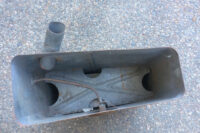
Air silencer/filter
QUESTION;-
Is there any way to remove the wire wool in the air filter housing. Other than using a scribe to hook it out. Or should I leave it and just wash it out in paraffin?
ANSWER;-
Its a ‘silencer’ not and air-filter. The mesh is permanent. I wash mine in petrol (cheaper than paraffin), dry it, then put oil on the mesh to stop it rusting. The only ‘air-filter’ on Y Types is the export version Oil-Bath type.
QUESTION;-
Petrol Filler Cap
I am about to remove the filler neck from my YB (0279) to fit a new seal where it goes through the inner rear wing and a new filler cap (from MGOCC). Can you tell me which way up the cap should be fitted – ie hinged at the top so that you have to hold it open to fill the tank, or hinge down so that the cap falls open if the catch is knocked?
ANSWER
Filler neck can be at any angle, I’ve seen many at odd ones. In the photos of the time the cap opens towards the rear door, but slightly downwards so it will stay open.
1st QUESTION;-
Fuel Starvation
I have just been out in my YT and a mile down the road I lost power as if only firing on 2 cylinders. I turned round and just about limped home with a couple of stops on the hills when with relief I arrived on my drive, I pulled the plug leads off one by one they all had a good spark (electronic ignition) and the erratic firing continued unchanged. I then got her back in the workshop where she fire up on full power again making further investigation difficult. Before I venture out again could you confirm my thinking or suggest another possible reason. Could it be one of the float chamber must have stuck closed causing petrol starvation in two cylinders. I have recently had my petrol pump pack up on a busy roundabout and I had to fix a new spare pump I was carrying, one float chamber was disturbed whilst investigating the petrol starvation.
ANSWER;-
Was it damp and cold? You might have suffered carburetter-icing! The water (in all petrol) would have frozen up in the jet, starving the engine. It could also be another fuel-starvation as you say, poor pump delivery. The cure for carburetter-icing is a hot-spot in the inlet manifold, something the YT does not have! Other causes might be blocked filter in the petrol-pump, muck in the bottom of the jet-tube, but I would go for the first two.
2nd QUESTION;-
I have had the YT running in the garage at full temp she started well and after a short while returned to the loss of power. As the only major change recently I am suspecting the new petrol pump being erratic. When the weather dries up a bit I will venture out
again.
UPDATE
The new pump was not new it had a blockage on the intake which eventually caused it to pack up. The points on the old pump have been cleaned and it has been re-fitted all is running well now.
QUESTION;-
Heat shield
Any suggestions to cure hot starting problems on the twin carb engine? Difficult to fit insulating blocks.
ANSWER;-
Alas, you need to insulate the carbs, try a few thick gaskets, about an eighth of an inch-worth. A heat sheild is also vital.
QUESTION;-
Fuel gauge readings
Any suggestions as to how I can get my fuel gauge to stop telling lies?
ANSWER;-
The guage is just a voltmeter, it reads the signal from the variable resistor mounted in the tank woked by a float. The tank-mounted ‘float switch’ can wear through the copper wire windings and give odd readings; the EARTH at the float switch needs to be a good one, it often is NOT causing high resistances and false readings. Remove the switch from the (empty) tank, connect it up and operate it by hand whilst watching the guage. New ones can be had from NTG of Ipswich. Hopefully the car has been re-wired with modern plastic insulated wires; if not the wiring may also be very suspect, especially those behind the dash that become brittle (old cotton covered rubber wires are dangerous now). When re-fitting or fitting a new float switch, make sure the float has a free -arc’ to move in and does not hit any of the baffles (just bend the floats wire arm to suit). Also use a sealant that is resistant to petrol (Hylotyte) on BOTH sides of the gasket (beware using old cork ones as the ethanol in the fuel disolves the glue holding the tiny bits of cork together….also beware shearing off the six set-screws holding in the float switch, un-do;do-up;un-do;do-up until you’ve freed it up.)