
XPAG Steady Bar.
If you are lucky enough to have a parts manual for your TD, TF, YA, YB or YT, you will find an engine steady bar, part number 500340 somewhere in it. Out of sight and out of mind until….
Back in May this year I was en-route to the Y Register’s Spring Run. As we climbed the hill on the road between Waddesdon and Thame, just after leaving the A41 the car growled away in second gear, It is a steep hill that you cannot get a run at as it has 90 degree bends at the bottom and top. We began to accelerate as we reached the summit and the speedometer needle crept past 25mph, gaining. But right in the middle of the top bend was a massive pot-hole. I was far too late to avoid it and the offside front wheel crashed through it, shaking the poor car to its foundations. I pulled over to check if anything had broken. As far as I could see, there was nothing amiss so we continued.
Fast forward to early August, I had been having the odd ‘clonk’ from somewhere at the front. It seemed to sound on going over sleeping policemen and the odd pothole I could not avoid. It had now developed into an annoying dry rattle, especially at idle rpm. Parking up outside my sister-in-law’s house I opened the bonnet and grasped the engine’s rocker cover and shook it. There was that rattle. It appeared to be a loose engine steady bar. The little rubber bushes on the ends do break up with age, leaving the engine to rattle about between the big washers. ( See the diagram from the workshop manual). The steady bar itself appeared to be reasonable firm, not a lot of play, but see later.
That afternoon I tackled the job, intending to fit new rubbers. The bar end under the thermostat housing and behind the water pump pulley is a really difficult area to get at, but having spent half my working life fixing (RAF) aircraft engines in-situ my fingers are still pretty nimble in my mid-70s. After a couple of hours, draining coolant, removing hoses, removing the dynamo, removing the fan, I could feel the the bar’s end was loose but not the bracket. Odd. Upon undoing the stud and the bolt that secure’s this bracket to the front of the engine, it all fell to bits. The bracket was in three pieces, the breaks both along the folded metal corners. It appears to have been bent as cold steel, not good for reducing stresses. I assumed that big pothole had caused the mass of cast iron engine to be shoved sideways, but had resisted and the bracket (part number 126854) was the weakest bit so it broke, or at least cracked to later break up. The bar itself was been held in place between the bolted and nut & stud bits, resting on top of the timing chain cover; hence the rattle.
A new one was fitted and I put a post on the Y Register’s Facebook page ( FB is always a good place for the ‘experts’ to vent their knowledge though not always correct), this bought back the comment from a Australian owner that he had a collection of such brackets, all broken due to the state of many Aussie roads. It was again very fiddly re-fitting the bar, which had to be done in sections before screwing it together (one half has a left-hand-thread, the other a right-hand-thread, as in a cable turn-buckle…..anyone who has set up cable controls on aircraft will recognise this). The bar simply needs adjusting to sit un-stressed with the engine not running. The Morris Minor 1000 had a similar steady at the rear of its cylinder head, rather infamous for ripping itself out of the side of the battery box if adjusted incorrectly and pre-stressing it. The XPAG’s bracket is held to the block by a bolt on the dynamo side, and a stud and nut the off-side. Beware that this bolt is sometimes broken through into the water jacket so requires some gasket glue on its threads (Hylomar in my case, as used on Rolls Royce Aero-engines)
Once all the bits that were removed for access, and the coolant added to the radiator, the rattle had gone.
-

- 1) XPAG Engine Steady Bar diagram.
-

- Steady bar connection to the chassis/damper tower.al Camera
-
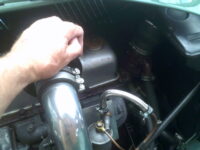
- 3) Giving the engine a test by trying to moves it from side to side.
-
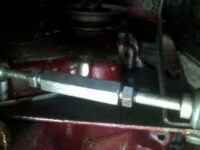
- 4) The ‘turn-buckle centre section for adjustment, with locking nuts.
-
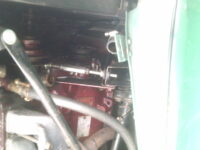
- 5) Hoses, etc removed for access.
-
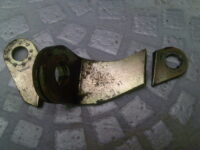
- 6) This should be one item, not three.
-
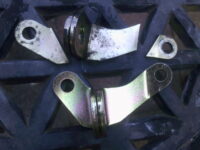
- 9) The new bracket.
Neil Cairns